nothing nothing nothing
Situation   You are at: Homepage > Donors > All you need to know about blood > FAQ
nothing Donors nothing
nothing
nothing
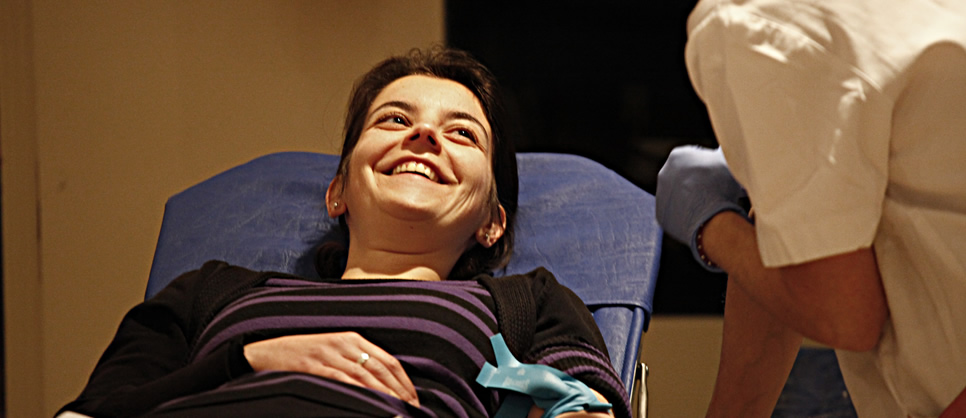
You can give blood in the time it takes to write an e-mail
nothing
Did you know that...
Dot
nothing
nothing
All you need to know about blood
Preguntes freqüents
Què és la sang Què en fem de la sang Qui pot donar sang L'afèresi Flash:Procés donació Plasmapheresis
nothing

Archive Frequently Asked Questions
Question When can I start giving blood?
Answer The law states that anybody of legal age, i.e. over the age of 18, can give blood. Donors must weigh more than 50 kg and be in good health. You can give blood up to the age of 65. Once a donor reaches this age, the doctor taking the blood must give his or her consent each time blood is given.

Question How often can I give blood?
Answer You must leave a gap of at least two months between donations. Women are advised to give blood no more than three times a year; men, no more than four.

Question Does blood change according to race or ethnic group?
Answer No. Everybody has a specific ABO group and transfusions can be carried out if the ABO group of the donor and the recipient are compatible, regardless of their race or ethnic group.

Question Is blood pressure important for giving blood?
Answer Yes Potential donors always have their blood pressure taken before they give blood. Those with a maximum pressure of over 18 mmHg or a minimum of over 10 mmHg cannot give blood. However, hypertensive donors who are monitored and receiving treatment can give blood if their pressure is normal at the time of donation. People with low blood pressure can give blood without any problems.

Question Is there a substitute for blood?
Answer In short, no. The human body - and more specifically, the bone marrow - is responsible for "producing blood". It is very likely that we will be able to produce genetically engineered blood in the not-too-distant future. For the time being however, blood can only be obtained through donations. All the money and all the insurance in the world don't mean a thing if there is nobody to give blood. An anonymous, voluntary and altruistic gesture.

Question Do I need to do anything in particular before I give blood?
Answer It is a good idea to eat something beforehand. Basically, eat what you normally eat, and drink a little more than usual if you can. Do not take aspirin or anything containing acetylsalicylic acid for at least 72 hours before giving blood, as it affects normal platelet functions.

Question Are any check-ups carried out before blood is given?
Answer Yes. A series of details are taken from all blood donors (age, date of birth, address, telephone number, etc.). They are then given a questionnaire to fill in and a drop of blood is drawn to determine haemoglobin levels. Pulse and blood pressure are monitored too.

Question Does it hurt?
Answer You will only feel the needle as it enters the vein. Afterwards, it should not hurt if done properly.

Question How long does it take to give blood?
Answer The nurses who take the blood are efficient and well-prepared, and can carry out the operation in seven to ten minutes. During this time, a 450-cc bag is filled with blood. Once you have finished, you should have a little refreshment, especially something to drink, to help replenish your body's blood levels. You can expect giving blood to take around half to three quarters of an hour in total.

Question How long will it take to replenish the blood levels?
Answer Blood levels will be fully replenished within four or five hours. White blood cells take 12 hours to recover and platelets take three days. Red blood cells take the longest to be replaced: two months. This is why it is important to leave a two-month gap between blood donations.

Question Can I give blood while menstruating?
Answer Yes, if you feel well enough.

Question How will I feel after giving blood?
Answer Most donors feel fine after giving blood. Only one in every 200 donors feels sick afterwards. To avoid this feeling, you need to drink more than usual during the 12 hours after giving blood. Eating and drinking before you give blood will also help you avoid feeling sick.

Question Can I catch an infectious illness by giving blood?
Answer No. No, you cannot catch any infectious illness by giving blood. Only disposable materials are used, so they are used for one donor only.

Question What happens to the blood after it is taken?
Answer After you have given blood, it is stored at a temperature of 2-5ºC and undergoes a series of tests to rule out the presence of hepatitis B or C, or the AIDS virus, and the reaginic test for syphilis is carried out; ABO and Rh blood groups are also determined, and irregular antibodies are analysed.
The bag of blood is separated by centrifugation into different components: from one bag, we obtain red blood cell concentrate, platelet concentrate, and one unit of plasma.

Question Can you play sport after giving blood?
Answer It depends on the sport in question and how hard you play. In general, you can play sport as long as you do not overexert yourself. People who train regularly should simply drink plenty of fluids in the hours after giving blood. However, people who do not play sport regularly or who carry out intensive training should be more careful and wait for about six hours.

Anyone who plans to do a high-risk sport (such as climbing, diving or scuba diving) within 12 hours after giving blood should not give blood.

Question Can you give blood when pregnant, after giving birth or after having a miscarriage or an abortion?
Answer Pregnant women should definitely not give blood. You should wait for six months after giving birth or having a miscarriage or an abortion before giving blood. In addition to these six months, mothers who breast-feed should not give blood until they stop breast-feeding.

Question Can you give blood after having a piercing or acupuncture?
Answer Piercings and acupuncture are not in themselves reasons for not giving blood, as long as they were carried out with sterile disposable material. If this was not the case, you should wait for four months before giving blood.

Question Can you give blood after having a tattoo?
Answer You should always wait for four months after having a tattoo before giving blood.

Question Can you give blood after an operation?
Answer The exclusion period will depend on the kind of operation:

After minor operations, e.g. haemorrhoids, varicose veins, injury stitching and hernias: you should not give blood for two weeks or until you have completely recovered.

After major operations, e.g. pneumonectomy, heart operations or chest surgery, gastrectomy, craniotomy, serious fractures (femur, pelvis, etc.) and articulation prosthesis (hip, knee, etc.): people who undergo major operations should not give blood for six months.

Question What should I do to donate organs and tissues?
Answer Spanish legislation is very progressive in this respect and stipulates that all citizens are potential donors of organs and tissues unless they express their wishes to the contrary. In this country, it is not necessary to present any document signed by the deceased person. However, authorisation by the next of kin is required for organ extraction. For this reason, it is important that the family and friends of the potential donor are aware of their will.

In Catalonia, the organisation responsible for organ donation is the Catalan Transplant Organisation (Organització Catalana de Trasplantaments - OCATT). For further information, call +34 93 339 83 03 or visit their website: www.ocatt.net.

Question Why do the analyses of donations not take into account other aspects that could be of interest to the donor?
Answer Blood banks are constantly striving to improve the safety of transfusions, and an important part of their budget is allocated to analyses. Since these analyses are complex and very expensive, we concentrate resources on those that are absolutely vital for guaranteeing maximum safety and exclude any tests that are not necessary for transfusions.

In addition, most tests have to be carried out on an empty stomach for reliable results, whereas you are recommended to have eaten before giving blood.

Support image
Go to top of page  Up